| Sign In | Join Free | My xxjcy.com |
|
| Sign In | Join Free | My xxjcy.com |
|
| Categories | Marine Anchors |
|---|---|
| Brand Name: | JC Maritime |
| Model Number: | Admiralty Anchor |
| Certification: | CCS.ABS.LRS.BV.GL.DNV.NK.RMRS |
| Place of Origin: | China |
| MOQ: | 1PCS |
| Price: | USD 800~1200 PER PIECE |
| Payment Terms: | T/T,Western Union,L/C,MoneyGram,D/A,D/P |
| Supply Ability: | 15000 Metric Ton/Metric Tons Per Year |
| Delivery Time: | 10-45 Days |
| Packaging Details: | 1. Bare packed: packed in bundles 2. Packed in iron drums then on pallets 3. Packed in woodencase 4. Required by cllent shipping |
| Product Name: | Size 50-10000kg CJD-14 HHP Anchor High Holding Power Marine Anchor |
| Material: | High - Strength Alloy Steel/Stainless Steel/Carbon Steel |
| Surface Finishing: | Polished,Spray Paint,Galvanized |
| Color: | Black/Red/Yellow Or Customer Demand |
| Certificate: | ABS,BV,DNVGL,KR,LR,NK,RINA,CCS,PRS,IRS,RS,CRS Certificated |
| Design: | Simple And Sturdy |
| Port Of Loading: | Qingdao, China |
| Company Info. |
| Qingdao Jincheng Maritime Technology Co., Ltd |
| Verified Supplier |
| View Contact Details |
| Product List |
The Spek anchor is the mainstream type of stockless anchor. It boasts core advantages such as sturdy structure, convenient operation, reliable grip, and strong adaptability. It is widely used in merchant ships, engineering vessels, cruise ships, and yachts, and is suitable for various seabeds including sand, mud, and gravel. The mainstream models include Type 95, Type SR, and Type M, which can cover weight requirements ranging from 40kg to 26,000kg for the entire ship.
Material Advantages:
Stable pulling force: On regular seabeds (sand, mud), the pulling
force performance is reliable, meeting the daily anchoring needs of
merchant ships, with high cost-effectiveness.
Easy operation: The absence of cross-bar design simplifies the
retraction, storage and reassembly process, reducing the
operational intensity of crew members and improving work
efficiency.
Low maintenance cost: The cast steel structure is sturdy and
durable, with adequate surface protection treatment. Daily
maintenance only requires regular inspection of accessories and
surface coatings, making the maintenance simple.

Manufacturing Process:
The production process of Admiralty Anchors strictly adheres to marine anchor casting standards and offshore mooring equipment strength requirements, centered on “structural precision, material strength and toughness, and corrosion resistance compliance.” Specific steps are as follows:
### 1. Raw Material Preparation and Mold Design
- Select high-strength cast steel (ZG230-450) or premium marine
carbon steel. Ingredients are blended according to chemical
composition requirements to ensure compliance with carbon,
manganese, and other elemental content standards, enhancing tensile
strength and toughness.
- Design sand molds based on anchor specifications (weights ranging
from 500kg to 50t). The mold cavity precisely replicates the naval
anchor's “four-fluke crown + crossbar” structure. Thickened
sections are incorporated at the anchor fluke-to-shank junctions.
Mold inner walls undergo polishing to prevent surface defects in
castings.
### 2. Monolithic Casting
- Molten cast steel (1500-1600°C) is injected into the mold via a
pouring system using gravity casting. This ensures uniform filling
without dead zones or porosity.
- After natural cooling to room temperature, the mold is opened to
remove the anchor blank. Gates, risers, flash, and other excess
material are trimmed to prevent residual stress-induced cracking.
### 3. Structural Reinforcement and Precision Machining
- Critical load-bearing areas like anchor claws and crown undergo
forging reinforcement to enhance localized hardness and impact
resistance. Claw edges are ground to ensure sharpness and improve
seabed gripping efficiency.
- Machine the connection hole at the top of the anchor body (to
match anchor chain specifications). Bore the hole walls smooth to
ensure secure chain attachment. Secure the crossbar via welding or
integral casting. Apply full-penetration welding at joints and
perform non-destructive testing.
### 4. Surface Anti-Corrosion Treatment
- Perform sandblasting rust removal first to thoroughly eliminate
surface scale, rust, and oil contamination, achieving Sa2.5
standard to enhance coating adhesion.
- Apply a dual-layer coating of “epoxy zinc-rich primer +
marine-grade topcoat” (total thickness ≥150μm) or utilize hot-dip
galvanizing (zinc coating thickness ≥85μm). Both methods
effectively resist offshore seawater corrosion and salt spray
erosion.
### 5. Finished Product Inspection and Quality Control
- Visual Inspection: Verify anchor body is free of cracks, pores,
pinholes, or other defects. Structural dimensional deviation ≤ ±3%.
Anchor fluke symmetry and crossbar verticality meet design
requirements.
- Performance Testing: Conduct tensile strength testing (≥400MPa)
and impact toughness testing. Perform simulated holding force tests
on samples to verify holding force meets standards (≥8 times its
own weight).
- Corrosion Resistance Testing: Pass salt spray testing (1000 hours
continuous) to evaluate coating or galvanized layer durability,
meeting offshore long-term service requirements.
- Compliance Certification: Products must obtain certification from
classification societies such as CCS and ABS, ensuring compliance
with GB/T 5468-2019 “General Technical Conditions for Marine
Anchors” and offshore mooring equipment standards.
### 6. Packaging and Shipping
- Packaged securely on wooden pallets or steel frames to prevent
deformation during transit. Anchor bodies are wrapped in
moisture-proof film to protect anti-corrosion coatings.
- Includes product inspection reports, certification documents, and
installation manuals for seamless offshore project integration or
on-site deployment.

Rackless compact design: Eliminates the traditional crossbar
(Stock), facilitating storage in the anchor hole, making operation
and retraction more efficient. Especially suitable for modern ship
anchor chain pipes and anchor hole layouts, reducing deck
occupation and operational risks.
Structural strength and material: Cast in one piece using ZG200-400
and other marine cast steel, with anchor crown having a top plate
and reinforcing ribs, enhancing bottom gripping stability and
penetration ability; anchor claws and anchor shaft can rotate
approximately 45° around the pin shaft, with both claws entering
the soil simultaneously, with a grip weight ratio of 2.5–4, meeting
mainstream classification societies' CCS, ABS, LR, DNV, etc.
certifications.
Damage prevention and balance optimization: When retrieved, the
anchor claws naturally point upwards and flip over upon contact
with the hull, avoiding damage to the outer plates; the low center
of gravity design (such as Type SR) further improves bottom
gripping efficiency and stability, suitable for harsh sea
conditions.
Specifications and compatibility: Weight range from 40kg to
26,000kg, compatible with anchor chain diameters of 12.5mm to
162mm; surface can be treated with asphalt paint, anti-rust paint,
etc. for corrosion protection, suitable for different navigation
environments.


Commercial shipping: The bow anchors or backup anchors of
mainstream commercial ships such as bulk carriers, container ships,
and oil tankers, suitable for both ocean and coastal routes, taking
into account both pulling power and operational efficiency.
Cruise ships and luxury yachts: Models like Type SR feature a low
center of gravity and damage prevention design, suitable for the
anchoring needs of large cruise ships and yachts, ensuring the
safety of passengers and the integrity of the ship.
Engineering vessels: Positioning anchors for dredgers, cranes,
platform supply ships, etc., for operations, capable of
withstanding frequent anchoring and complex seabeds, providing
stable positioning capabilities.
Fishing and small vessels: Main anchors for small fishing boats and
work boats, with a compact design for easy storage, suitable for
nearshore and coastal operations.
Marine facilities: Permanent mooring anchors for buoys, lighthouse
ships, offshore wind power platforms, etc., resistant to long-term
seawater corrosion, ensuring the stability of facilities.
Selection Suggestions
Match the anchor weight with the ship's deadweight tonnage and the
anchor chain specification, following the classification society's
norms.
For sandy/mud-bottomed sea beds, Type 95 is preferred; for complex
sea conditions or large ships, Type SR is recommended.
The anchor chain for the matching system must undergo tension
testing to ensure it matches the strength of the anchor claws,
thereby enhancing the reliability of the overall anchoring system.
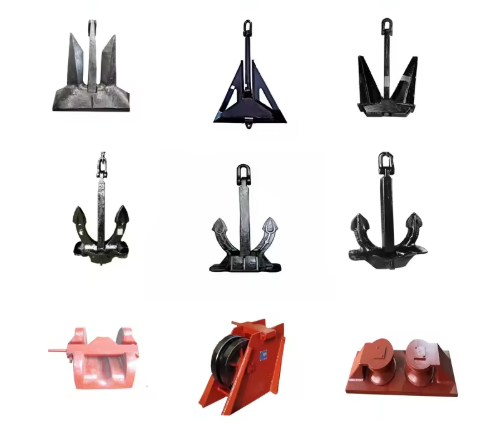
After-sales consultation: We provide 24/7 customer service to answer customer questions , such as specification selection, usage methods, and maintenance points.
Backed by decades of marine hardware manufacturing expertise, our
anchors comply with international marine standards and undergo
rigorous quality testing—including load-bearing tests, corrosion
resistance tests, and seabed simulation trials—to ensure
reliability. We offer customization services for size, material,
and surface treatment to meet the unique requirements of different
vessels and marine projects.
Trust our Marine Anchor to secure your vessel with uncompromising
strength and stability, even in the most challenging marine
conditions.

With class-certified quality, robust construction, and reliable
performance, our Spek anchor is a trusted choice for shipowners and
operators worldwide. It not only meets the strictest safety
standards but also delivers cost-effective, long-term mooring
solutions for diverse marine applications.
We can customize anchor specifications according to your vessel’s
unique requirements. Contact us today for detailed technical
drawings and quotation!
Any question please let us know ,our JinCheng maritime will provide
you the best service with 7*24 hours ~

|
 Black Bitument Paint AC 14 Anchor for Marine Vessels and Boats Ship Building Ports
Marine and Offshore Ship 50-29000kg for Spek Anchor with Class Certificate
Carbon Steel Danforth Marine Anchor HHP Danforth Anchor
Marine Pool TW Anchor (High Holding Power Marine Anchor) Anchoring Mooring Kayak Yacht Boat Hardware
Stevshark Mk5 Anchor Ultra High Holding Power Hhp Anchor for Offshore and Aquaculture Mooring
High Quality Factory Price Spek Anchor Marine Ship Anchor BV,LR,RINA,DNVGL,RS,CCS,ABS,NK,KR..
AC-14 Anchor Casting Steel Material Stockless Hall HHP with High Holding Power for Cargo Ships
Size 50-10000kg DELTA Marine Anchor with LR Certificate China Shipping Marine Equipment/Certification CCS.ABS.LR.BV.GL.DNV.NK
JIS Stockless Anchors, Ship Boat Marine Anchor with BV,LR,RINA,DNVGL,RS,CCS,ABS,NK,KR... and Cast Iron, Cast Steel, Malleable Steel, Stainless Steel Etc.
Black Bitument Paint AC 14 Anchor for Marine Vessels and Boats Ship Building Ports
Marine and Offshore Ship 50-29000kg for Spek Anchor with Class Certificate
Carbon Steel Danforth Marine Anchor HHP Danforth Anchor
Marine Pool TW Anchor (High Holding Power Marine Anchor) Anchoring Mooring Kayak Yacht Boat Hardware
Stevshark Mk5 Anchor Ultra High Holding Power Hhp Anchor for Offshore and Aquaculture Mooring
High Quality Factory Price Spek Anchor Marine Ship Anchor BV,LR,RINA,DNVGL,RS,CCS,ABS,NK,KR..
AC-14 Anchor Casting Steel Material Stockless Hall HHP with High Holding Power for Cargo Ships
Size 50-10000kg DELTA Marine Anchor with LR Certificate China Shipping Marine Equipment/Certification CCS.ABS.LR.BV.GL.DNV.NK
JIS Stockless Anchors, Ship Boat Marine Anchor with BV,LR,RINA,DNVGL,RS,CCS,ABS,NK,KR... and Cast Iron, Cast Steel, Malleable Steel, Stainless Steel Etc.

